

If you have ever sat in an IEP meeting and felt like nobody in that room truly understood what was going on with your child, this post is for you.
Is dyslexia a learning disability? Yes. Officially it is. But here is what that label does not tell you: dyslexia is a specific kind of learning disability that requires a specific kind of help.
Lumping it in with every other learning challenge and calling it covered is one of the most frustrating things that happens to dyslexic kids in school, and it happened to our son for years.

What Dyslexia Actually Is
Before I get into our story I want to be clear about something because there is still a lot of confusion out there and I lived with that confusion for a long time.
Dyslexia is a language processing difference. It affects how the brain decodes written words. It is not a sign of low intelligence. It is not a behavioral problem. It is not laziness and it is not a lack of effort.
It is a specific, well-documented neurological difference in the way a person reads and writes. That is the whole thing.
Everything else about our son, his ability to think, solve problems, learn from experience, and figure out complex tasks, was completely intact. Dyslexia affected one narrow channel of how his brain worked.
The Classroom That Did Not Work
When our son was in high school he was placed in a special education classroom meant to support students with a wide range of learning needs.
I understand why schools do this. Resources are limited. Staff are stretched. Grouping students who need extra support makes logistical sense on paper.
However, in practice what it meant for our son was being in a room with kids who had behavioral disabilities, physical disabilities, and challenges that had nothing to do with language processing.
Some of those kids needed constant redirection. Some needed immediate physical intervention. The room was chaotic in ways that had nothing to do with reading or learning.
I remember one specific situation in high school. Another student was repeatedly turning the lights on and off. Over and over. The teacher was struggling to manage it or ignore it. (I wasn’t there) Our son, who had zero patience for wasted time and a clear sense of the chaos it was creating in the room, finally said out loud that if nobody was going to handle it he was going to.
He got sent to the office. He argued with the teacher and it wasn’t his job to discipline another student, so I get it. However, there were many instances like this and it showed me this was not the classroom for our son.
He did not learn a thing in that classroom. Not because he could not learn. Because the environment made learning impossible and nothing being taught was designed for what he actually needed.
Why the Same Help Does Not Work for Dyslexia
Dyslexia requires specific, structured, systematic reading instruction. You have probably heard of the Orton-Gillingham method. It is the gold standard and for good reason. It teaches phonics one skill at a time, in a specific sequence, with multiple senses involved.
It is not the same as general learning support. It is not someone reading things aloud to a student. It is a specific approach designed for the specific way dyslexic brains process language.
A student with autism who needs behavioral support does not need that approach. A student with a physical disability does not need that approach. Putting all of these students in one room and calling it support is not support. It is a holding pattern.
Here is where it gets personal for us.
OG is the right foundation. I believe that. But a method is only as good as the people using it and their willingness to pay attention to what is actually happening in front of them.
In elementary school, Our son was really struggling with the most basic words. We kept asking about trying something different. The answer was always the same. We need to stay consistent with the program.
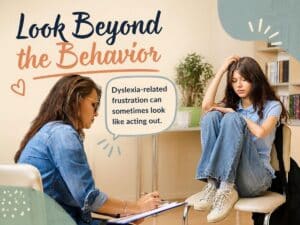
Here’s the thing. Our son was trying to tell them. He was frustrated. He was shutting down. He would actually tell the teacher, “This isn’t helping me”.
At some point the right move is to step back, look at the actual child in front of you, and ask whether the teaching or the curriculum might have something to do with the lack of improvement.
Can you tell I am getting worked up just talking about it?
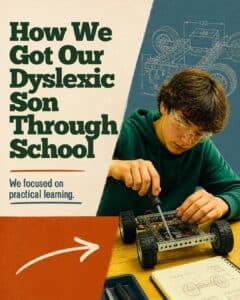
Kids with dyslexia excel with visual and hands on learning!
The Myth That Still Does Real Damage
People still assume that if a child cannot read well they are not intelligent. Teachers sometimes assume it quietly. Other kids pick up on it. And worst of all the dyslexic child starts to assume it about themselves.
Our son heard it in subtle ways throughout his school years. The way certain teachers talked to him. The expectations that quietly lowered without anyone saying so out loud. The placements that communicated more than any meeting ever did.
He knew. Kids always know.
What those people did not know was that the same brain that scrambled letters on a page could hold an entire engine’s worth of knowledge, troubleshoot problems in real time, and figure out solutions that other people missed. Dyslexia does not equal low intelligence!
Oh, don’t even get me started on those Standardized Tests!
What We Did Instead of Waiting for the School to Figure It Out
We stopped waiting and started doing more ourselves at home.
We worked on reading in ways our son was willing to do. Structured. Explicit. Fun. Active. One skill at a time. We used materials built for older kids because our son was not going to sit down with anything that felt like it belonged in first grade. He had dignity and we respected it.
We also shifted our focus. We stopped worrying about grade level. We just got to work learning and later on in his teens, we started asking what he needed to know to function well as an adult. Real life reading. Practical skills. Words that would matter when he was working and handling his own life.

What I Want You to Take Away
This is just our story. Some people have great outcomes with their school. There are wonderful programs and incredible teachers out there doing this right every single day. If you have one of those, hold onto them.
Most people do not find their way to a site like this because everything is going great.
If you are here, something is probably not working. And the first thing I want you to know is that you are not imagining it.
Dyslexia is not every learning disability. It is a specific one that needs a specific response. Generic support is not that response. And staying consistent with something that has not worked for years is not a strategy, it is just easier than changing course.
We ended up with a couple of great teachers the last 2 years of high school who went out of their way to advocate for our son. It was understood we weren’t going to get specific dyslexia help, but we got accomodations such as longer test taking time, tools for writing essays and a quiet room to take tests if needed.
At home is where we continued with his dyslexia support with a lot of the printables you will see here through out this site.

Everything I share here came from years of sitting across the table from a kid who learned differently. The printables in the shop are what we actually used. If you are looking for something age appropriate and built for an older struggling reader, start here.

I am a mom sharing our story with dyslexia. This is not professional educational advice. Every child and every family situation is different.