
My youngest son graduated from high school this year.
I’m going to let that sit for a second, because for a long time I wasn’t sure I’d get to write that sentence. There were years when getting through one week of school felt like climbing a mountain, and getting a dyslexic son through twelve years of school felt impossible.
We did it. It just didn’t look anything like the plan.
If you’re a mom in the middle of it right now, with a kid who hates reading, melts down over spelling, and can’t sit still for ten minutes, this post is for you. I don’t have a perfect system to hand you. What I have is what worked for one stubborn, funny, resourceful kid, and I’m sharing it in case it helps yours.

It Wasn’t Just Reading
Most people think dyslexia means trouble with books. For us it showed up much earlier, and in places nobody warned me about. Left and right. Tying shoes. Directions that other kids picked up without thinking.
Then it showed up on the football field.
My son was in 4th grade, and the playbook was full of X’s and O’s, holes, and lefts and rights. That’s a lot to ask of any kid, and a lot more for a kid whose brain doesn’t hold left and right the same way. The minute his coach found out he was dyslexic, he took the bull by the horns. He set the playbook aside for my son and kept it simple. Names instead of diagrams. “Get the ball and run down the sideline.” My son was fast, so that was all he needed.
It wasn’t the NFL, and we appreciated that his coach saw it that way. No big deal, we’ve got this.
I think about that coach a lot. He didn’t need a meeting, a form, or approval from higher up. He just adjusted.
(Want the full story? The Football Coach Who Stopped Using the Playbook)
Why School Wasn’t Working for Our Dyslexic Son
School was a different story.
The school had a system. It just wasn’t working for him. When we said so, they couldn’t try anything different, because anything outside the standard approach had to be approved higher up. Meanwhile my son sat through lessons that weren’t clicking, fell a little further behind every week, and got more and more frustrated.
Here’s something I’ll say loud and clear, because I wish someone had said it to me. Not every dyslexic child does well with the standard curriculum. The program that our son was using wasn’t working. He either had too much attitude about it, or it just wasn’t clicking, and it was never going to. That’s not a failure on his part.
We needed to think outside the box and figure out what was going to work. I made the decision to pull him out and start homeschooling him. We needed to start at the beginning instead of continuing to push him through the grade levels when he was struggling with learning the most basic sight words and sounds still.
I also want to be fair. Some of his teachers were wonderful and went out of their way for him. Others just didn’t want to be bothered with it, and yes, there are teachers like that. I’m not saying that to point fingers. I’m saying it because if you’ve run into the same thing, you didn’t imagine it, and you’re not the only one.
The Attitude Nobody Warned Me About
If your child is an older boy, you may already know this part. If you don’t, I want you to hear it now.
The older he got, the more defiance I got. I’ll never forget when we were tapping out sounds on his arm, the way the program said to, and he told me exactly where I could shove that dumb stuff. He said it was stupid. He said it dozens of times: “It’s not working.”
And you know what? He was right. It wasn’t working, and being told to keep doing it, only harder, wasn’t helping either of us.
Dyslexia in older boys doesn’t always look like a kid who can’t read. Sometimes it looks like attitude, deflection, the class clown, the shrug. It looks like a kid who can’t sit still after being asked to read, write, and spell for long stretches, day after day, and struggling at it in front of everyone. That anger was frustration, and I had to learn to hear it.
So I decided to start listening.
(More on this:Why Do Dyslexic Boys Act Out Instead of Asking for Help?
What We Did Instead
Once I listened, he told me what he needed, even if he never said it in those words.
He needed a break. Long stretches of sitting were a recipe for a meltdown, so we stopped doing them. Short sessions, then done.
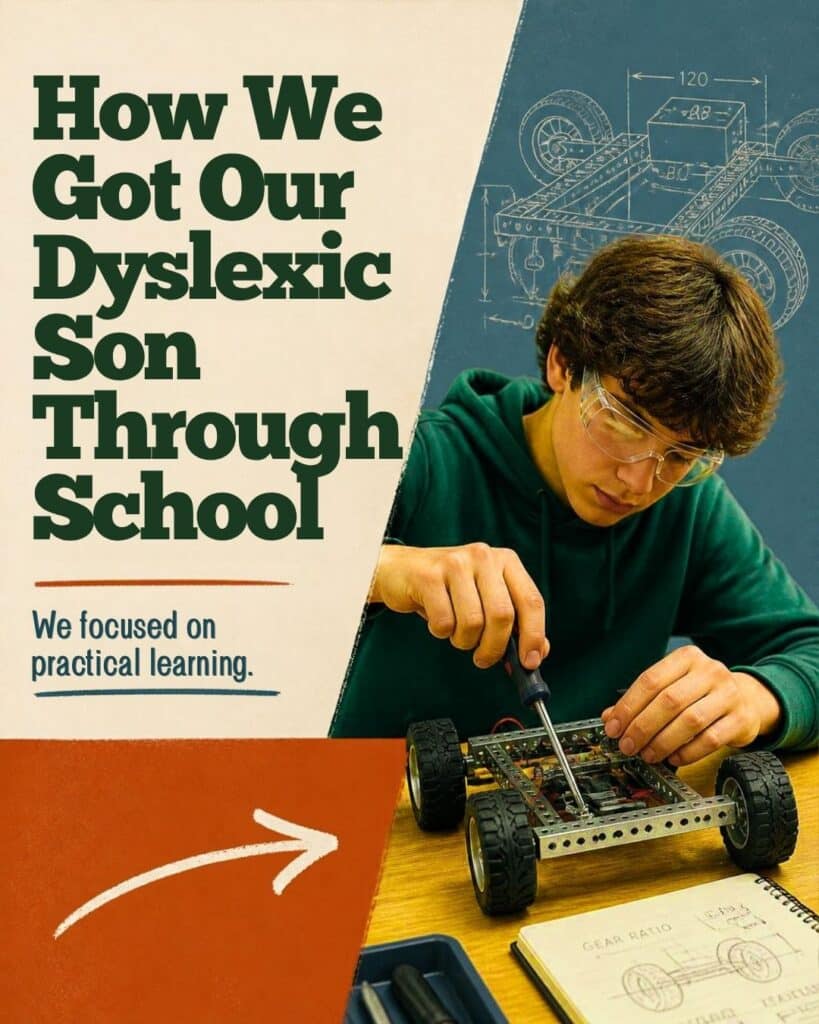
He needed to work with his hands. When his hands were busy, he could stay with us. Building, fixing, doing.
He needed to see words connected to actions and things. A word attached to something real, something he could do or touch, stuck in a way a worksheet never did.
We still did phonics. We just did it with more action and less sitting. He didn’t get all of it. He still doesn’t, and he may never. I’ve made peace with that, because it taught me something bigger.
Work Arounds Are a Skill
Some parts of dyslexia don’t get fixed. Some things he just couldn’t do, and the real win was finding ways around them. Today my son is one of the most resourceful people I know. He just figures it out. He had to, and that skill came from his dyslexia, not in spite of it.
If you take one thing from this post, let it be this: teaching your child to find a work around is not giving up. It’s one of the most useful things you can give them.
What We Tried to Get Our Dyslexic Son Through School
Public school. Homeschool. Back and forth, depending on what was working. IEP meetings, tutors, programs, and plenty of things I made up as I went. Some of it helped a little. Some of it was a waste of money. What worked was paying attention to my son and changing course fast when something wasn’t working.
I’m not telling you to skip school or ignore the rules. I’m telling you that when the system doesn’t have what your child needs, and it can’t change fast enough, you build it yourself. And you keep advocating.
What I Want You to Know
You may not see progress for months. Sometimes you won’t see it for years. But it will happen, and it never happens when you’re looking for it. One day you’ll notice they did something on their own that used to be impossible, and you’ll realize it’s been growing the whole time.
Your child is not lazy. You are not doing it wrong. The fact that you’re up late searching for answers tells me you’re exactly the parent your kid needs.
His learning is still ongoing, it just isn’t at the kitchen table anymore. He’s a young man now, and I’m proud of every stubborn, frustrating, funny step it took to get here.
Keep Going
That’s the heart of why I built this site. Everything in my shop comes from those years, and I’m sharing it so you don’t have to learn it all the hard way.
And if you want to tell me where you are in your own story, I’d love to hear it. You’re not alone in this.



Everything I share here came from years of sitting across the table from a kid who learned differently. The printables in the shop are what we actually used. If you are looking for something age appropriate and built for an older struggling reader, start here.

I am a mom sharing our story with dyslexia. This is not professional educational advice. Every child and every family situation is different.